How to write an apartment listing that actually attracts buyers
On listing portals, you’re no longer competing with just a few apartments — often it’s dozens of similar offers in the same area. Buyers scroll fast, stop for a few seconds… and either click or move on.
That’s why your listing can’t be “average.” It’s your main sales tool. What matters most is:
- a realistic price,
- a specific, clear description,
- good photos,
- a smart way to present the location.
Below is a simple, practical step-by-step guide — including how to use Estify to price your apartment based on data.
1. Start with a realistic valuation
Before you think about the title, description, or photos, answer one question:
At what price does this apartment actually have a real chance to sell?
Market data shows that on the secondary market, the gap between asking price and final transaction price can reach even 10%+ in the largest cities.
That means:
- too high → the listing sits for weeks, and you end up cutting the price anyway,
- too low → you sell fast, but leave money on the table.
Estify helps you price based on data, not guesswork:
- you provide the location, key details, and standard,
- algorithms analyze dozens of market factors,
- you receive an online valuation report with a realistic value range.
This gives you a strong baseline for setting your asking price — for example slightly above the middle of the range, with room for negotiation.
2. Listing title: factual, not “poetic”
Before anyone reads your description, they see a photo thumbnail and the title. If the title is generic (“Amazing apartment in a great location!!!”), it disappears in the crowd.
Best practice is simple: keep it short and specific.
Include:
- type of property (apartment for sale),
- number of rooms + size,
- district / street area (not the full address),
- 1–2 key features (balcony, parking, metro, park).
Good examples:
- “3 rooms, 64 m², balcony, Przymorze – 10 min to SKM”
- “2 rooms, 48 m², renovated, city center, elevator”
Avoid:
- empty words like “luxury” or “unique” (unless it truly is),
- ALL CAPS,
- multiple exclamation marks.
3. Apartment description: start with facts, then add plain language
A good description is built on specifics. Buyers look for the same information every time.
What must be included:
- total size (m²),
- number of rooms + layout (separate rooms / walk-through),
- floor + number of floors in the building,
- building type and year (block, tenement, apartment building),
- technical condition (renovated / needs refresh / new wiring vs old),
- what’s included (built-in kitchen, appliances, wardrobes),
- extras (storage, basement, garage, parking space),
- ownership type (full ownership / cooperative ownership right),
- monthly fees and charges,
- availability date,
- whether the price is negotiable.
How to write it in a human way
Instead of:
“3 rooms, balcony, furnished kitchen, good transport.”
Write:
“The apartment has 64 m² and three separate rooms. The living room opens onto a large west-facing balcony, and there are two spacious bedrooms with room for wardrobes. A separate kitchen with a window makes it a great fit for a family or a couple working from home.”
Instead of:
“Nearby shops, great infrastructure.”
Write:
“Within a 5-minute walk: a supermarket, bakery, parcel locker, and a clinic. A tram stop is right next to the building, and the trip to the city center takes about 15–18 minutes.”
Simple. Clear. No hype.
4. Describe the location with real details (not “great location”)
Buyers don’t just buy an apartment — they buy a lifestyle. They want to know commute time, schools, and whether the area works for daily life.
Include:
- distance to public transport (tram/bus/metro/SKM),
- commute time to the city center,
- schools / kindergartens nearby,
- shops and services,
- parks and green areas.
Example:
“5 minutes on foot to a tram stop (3 lines), around 20 minutes to the city center. Two primary schools nearby, plus a public kindergarten and a private nursery. A park with a large playground and bike paths is a 10-minute walk away.”
5. Photos: in 2026 they are non-negotiable
Many buyers simply don’t click listings with poor photos (or none). Great photos are often half the sale.

How to prepare your apartment for photos
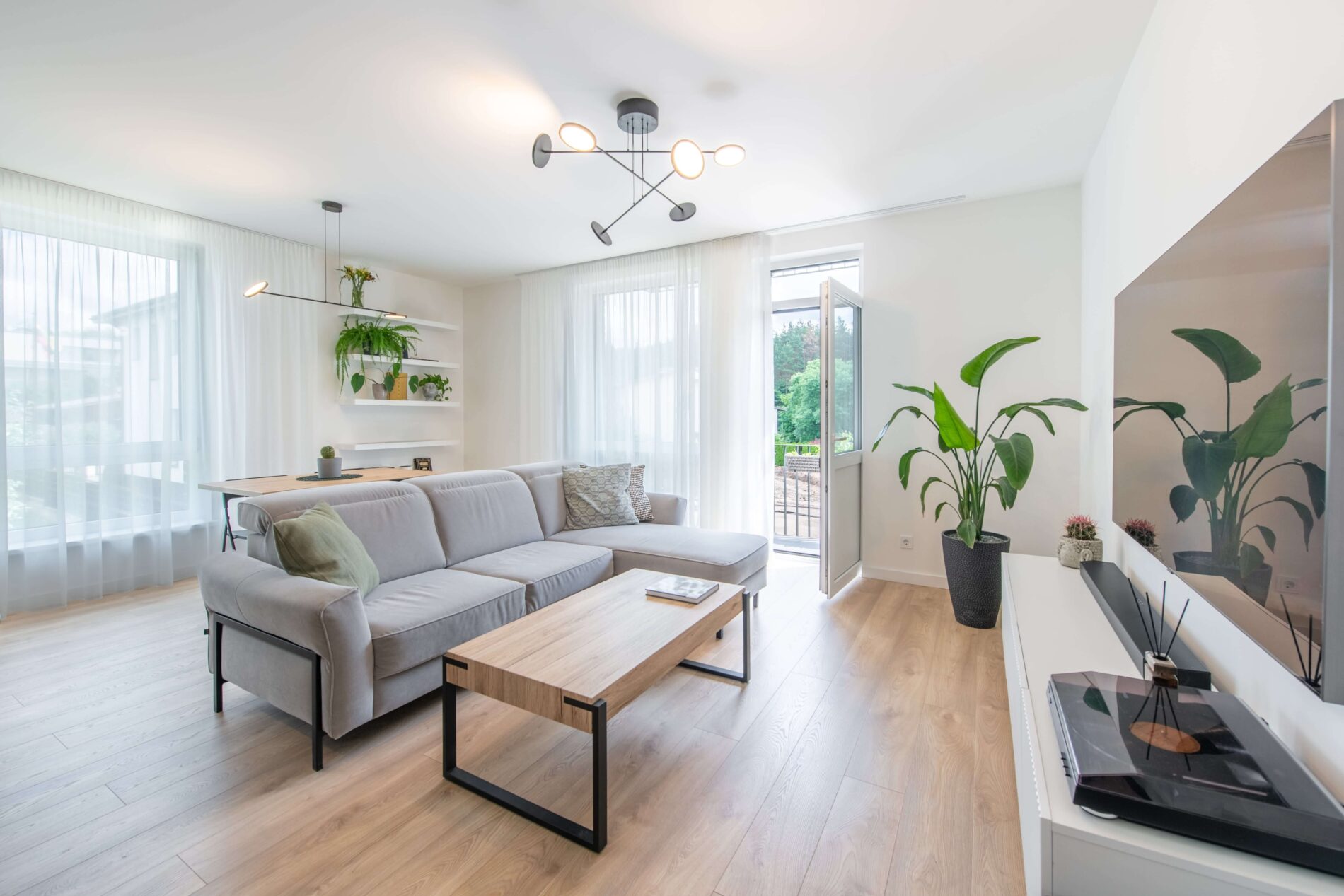
Declutter and clean
- hide laundry, detergents, random items, cables, bins,
- remove fridge magnets and notes,
- bathroom: no toothbrushes, cosmetics, or cleaning products visible.
Depersonalize
- remove some family photos and highly specific decorations,
- keep neutral items: a plant, pillows, a blanket, fresh flowers.
Use daylight
- shoot during the day with natural light,
- avoid evening “yellow light” photos,
- turn on lights only in darker rooms.
Angles and framing
- keep vertical lines straight (no tilted walls),
- show the whole room, not random corners.
Tech tip
A modern smartphone is enough — just don’t over-edit. Light correction is fine, but don’t make it look like a different apartment.
Many agents say a professional photographer pays off through a higher price and faster sale.
6. How to stand out from other listings
Beyond good text and photos, consider adding:
- Floor plan (even a simple one) — buyers love it.
- Short walk-through video (phone video is fine).
- Virtual tour / 3D (advanced, but strong conversion boost).
- Fully completed listing fields (fees, building type, year, heating, etc.) — helps visibility in filters.
7. Common mistakes that kill even a good apartment
Avoid:
- no price (“to be agreed”) — most buyers filter by price,
- dark, crooked, random photos,
- exaggerated language (“luxury apartment”) with no proof,
- vague claims (“great transport”) without numbers,
- mismatch between description and reality,
- a price disconnected from the market.
Summary: your listing is your sales landing page
A strong listing works like a well-built landing page:
- it starts with a realistic price (Estify helps with data-based valuation),
- it answers buyer questions with clear facts,
- it uses good photos to show real potential,
- it doesn’t oversell — it presents the property honestly.
Result:
- more serious inquiries,
- faster sale,
- negotiations based on facts, not hope.